Selecting chairs for a church requires careful planning beyond appearance and purchase price. Seating must accommodate the congregation, fit the available floor area, and support regular services. Some churches also use their halls for meetings, education, and community activities. These different needs affect chair design, layout, maintenance, and long-term costs.
For church administrators, project contractors, government procurement teams, and furniture distributors, choosing a manufacturer involves several practical checks. Product specifications, production capabilities, quality control, delivery schedules, and after-sales support all deserve attention. Comparing these factors helps buyers identify a supplier whose products and services match the project’s actual requirements.
What Does Your Congregation Need?
Begin with the number of expected attendees and the activities held in the building. Churches with several services each day may require durable upholstery and straightforward cleaning procedures. Multipurpose halls may need flexible layouts that can be changed for meetings, performances, or community events.
Floor planning is equally important. Buyers should measure the usable area and account for aisles, entrances, accessible routes, and space around the altar or stage. Chair dimensions alone cannot determine the final capacity. Row spacing and movement routes also affect how many people can be seated comfortably.
When evaluating worship seating, decide whether fixed rows or movable chairs suit the facility better. Fixed arrangements maintain consistent positions, while movable options offer greater flexibility. The decision should reflect staff availability, storage space, event frequency, and the time required to prepare the hall.
Which Dimensions and Features Matter?
Chair width, seat depth, back height, and row spacing influence both capacity and comfort. Buyers should compare these measurements with the floor plan instead of selecting chairs based on photographs. Mock layouts or sample installations can reveal clearance problems before a large order is placed.
Comfort also depends on cushion shape and back support. Ergonomic cushioning with lumbar support may provide a more supportive sitting position during lengthy services. Upholstery should be assessed for appearance, cleaning requirements, and suitability for the intended environment. Material samples can help procurement teams compare finishes before confirming an order.
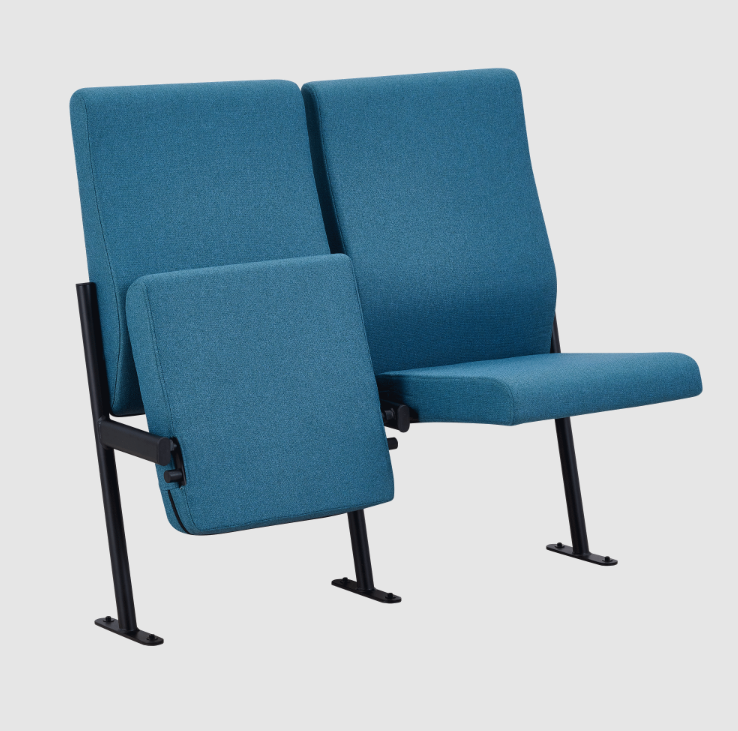
The Norr L-A13 provides one example of a space-conscious chair design. It features a European minimalist style, a fully upholstered outer back, and a fully upholstered seat pan. Its ergonomically shaped cushion includes lumbar support. The stated minimum row spacing is 31.5 inches, which gives planners a reference when assessing room capacity.
How Can Construction Affect Service Life?
Appearance does not reveal every detail of a chair’s construction. Buyers should examine the supporting frame, seat mechanism, upholstery attachment, and connection points. These components influence daily use and the maintenance work required over time.
The Norr L-A13 uses strong steel structural support and a counterweight tip-up seat mechanism. Its configuration can include a hardwood armrest or no armrest. Buyers should confirm the selected options and request relevant technical documents before approving the final specification. Test information should relate to the actual model rather than an unrelated product in the same range.
Maintenance planning should also form part of the purchase review. Ask which cleaning methods are suitable for the upholstery and whether replacement parts can be ordered later. Documenting these details helps facility managers plan routine inspections and respond to wear without disrupting scheduled activities.
Does the Manufacturer Control Its Production Process?
Production capability matters when a project requires hundreds or thousands of chairs. Buyers should ask how the supplier manages material sourcing, component manufacturing, assembly, finishing, and final inspection. They should also confirm production capacity and the proposed schedule for the required quantity.
Integrated manufacturing can simplify coordination when several processes contribute to one finished product. Mold development, metal processing, coating, injection molding, foam production, aluminum die casting, and wood processing may each affect component consistency. Procurement teams should establish which processes are handled internally and which depend on external suppliers.
For institutional furniture projects, worship seating manufacturers should also be able to clarify technical specifications and installation requirements. Useful documents include product drawings, approved configurations, material details, and packing information. Clear records help contractors coordinate the furniture order with building schedules and site conditions.
How Should Buyers Assess Quality and After-Sales Support?
Quality checks should cover materials, assembly, finish, and the completed chair. Buyers can request information about incoming inspections, production checks, and final acceptance procedures. Relevant certifications and test reports should be checked against the proposed model and the project’s requirements.
Warranty terms need the same level of scrutiny. Procurement teams should clarify the coverage period, exclusions, repair responsibilities, and process for reporting defects. Overseas distributors may also need information about spare parts, technical communication, and service arrangements across different regions. Written terms provide a clearer basis for comparing suppliers.
Leadcom seating lists a five-year manufacturer’s limited warranty against manufacturing defects under normal usage, together with lifetime maintenance. Its current website also reports more than 128 patents and provides information about its integrated manufacturing capabilities. Buyers should confirm the applicable warranty coverage and service arrangements for their projects. These capabilities can be considered alongside project references, technical documentation, and the supplier’s ability to meet agreed requirements.
Can the Supplier Meet Your Delivery and Installation Needs?
Delivery planning should begin with a confirmed quantity, production schedule, packaging method, and site access assessment. Projects involving several halls may require phased deliveries. Buyers should agree on unloading arrangements, temporary storage, installation responsibilities, and acceptance checks before production begins.
Installation documents can help contractors arrange rows consistently and verify spacing. Where appropriate, an approved layout drawing or sample installation can identify conflicts before the full order arrives. The procurement team should also confirm whether the quotation includes installation services or covers furniture supply only.
Future expansion deserves consideration as well. Churches may need additional chairs when attendance increases or room layouts change. Ask whether the same model, finish, and configuration may be available for later orders, subject to production availability. Keeping approved specifications and drawings on file can simplify repeat purchasing.
Make the Choice Against Clear Project Criteria
The right manufacturer should match the congregation’s needs, room dimensions, product requirements, budget, and service expectations. Compare quotations using the same criteria, including comfort, construction, maintenance, delivery, warranty, and installation support. Initial price is only one part of the purchasing decision.
For church administrators and institutional buyers, worship seating should be evaluated through practical specifications rather than appearance alone. Leadcom seating offers institutional furniture options, including the Norr L-A13, for churches, auditoriums, and multipurpose rooms. Reviewing the proposed configuration, technical documents, and written service terms helps buyers determine whether the supplier is suitable for their project.