Heavy aircraft, intense rainfall, expansive paved surfaces, and strict operational continuity make airport drainage fundamentally different from ordinary site drainage. Water must leave the pavement without creating conditions that interfere with aircraft movement or pavement performance.
A corrugated pipe manufacturing machine plays a role upstream by producing drainage pipes whose geometry, stiffness, and internal flow characteristics can be matched to the demands of airfield infrastructure. DEKUMA develops extrusion technology for specialized pipe applications where material structure and dimensional consistency matter.
How Airfield Loads Shape Drainage Pipe Design
Aircraft loading does not act directly on a buried pipe in isolation. Wheel loads pass through pavement layers, subbase, soil, and surrounding backfill before reaching the drainage structure. The resulting pipe load depends on factors such as pavement thickness, trench geometry, burial depth, soil properties, aircraft characteristics, and the stiffness of the surrounding system.
Ring stiffness becomes particularly important for flexible buried drainage pipes. Rather than resisting external loading solely through the strength of the pipe wall, a flexible structure can interact with the surrounding soil and distribute deformation through the pipe-soil system. Proper bedding and backfill compaction are consequently part of structural performance rather than merely installation details.
Aircraft category also influences the engineering calculation. A taxiway serving large commercial aircraft can experience substantially different loading conditions from a service road or light-duty apron. Drainage specifications should reflect the actual pavement section and design aircraft instead of assigning one generic pipe class to every airport drainage route.
Flow Bore and Stormwater Capacity
Structural strength alone does not determine whether an airport drainage system functions effectively. Runoff generated by large impermeable pavement areas can reach collection points rapidly during intense rainfall, making internal hydraulic capacity an important part of pipe selection. Diameter, slope, surface characteristics, inlet arrangement, and downstream discharge conditions all influence how efficiently water moves through the network.
A smooth internal bore can reduce flow resistance compared with a heavily obstructed passage. Corrugated drainage structures often place the reinforcing profile on the exterior while maintaining a comparatively smooth water-contacting surface, allowing structural geometry and hydraulic behavior to be considered separately.
Hydraulic calculations should also account for the storm event selected for the project. Rainfall intensity, catchment area, pavement grade, inlet spacing, and allowable ponding conditions determine the required conveyance capacity. Increasing pipe diameter may improve capacity, but the final dimension still has to work with trench depth, existing utilities, outfalls, and available longitudinal slope.
Manufacturing Control for Buried Airport Pipe
The production process has a direct connection with the consistency of finished drainage pipe. DEKUMA’s automotive multi-layer corrugated tube extrusion line is designed to produce composite corrugated structures using materials such as PA with PP or PE, primarily for new-energy vehicle cooling applications. Its stated multi-layer extrusion approach illustrates how controlled material bonding and dimensional stability can be incorporated into specialized corrugated products, although airport drainage pipe specifications require application-specific material selection and validation.
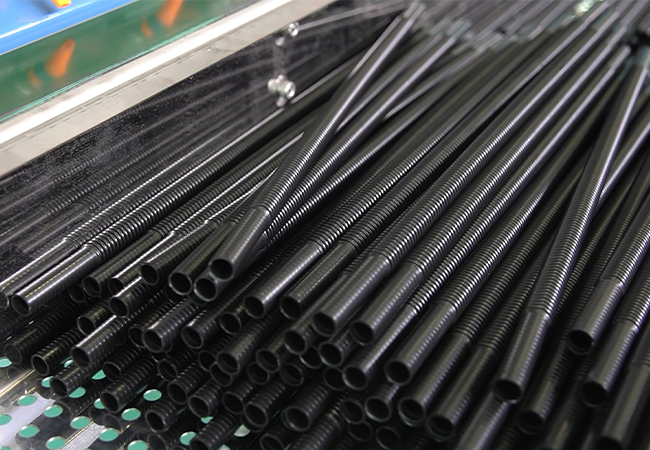
For a corrugated pipe making machine, stable profile formation matters because variations in wall geometry can influence stiffness, dimensions, and connection compatibility. The extrusion process needs controlled material flow, forming, cooling, and downstream sizing so that repeated corrugation remains consistent along the production length.
Airport projects also benefit from traceable quality requirements. Dimensional checks, ring stiffness testing, joint evaluation, and material verification can be incorporated into production inspection according to the applicable pipe standard and project specification. These checks provide measurable evidence that the manufactured pipe corresponds with the engineering assumptions used during drainage-system design.
Matching Pipe Specification to Pavement Design
Airport drainage should be designed as part of the pavement system rather than treated as an independent underground utility. Pavement thickness, subgrade characteristics, drainage-layer configuration, trench location, and expected aircraft traffic all affect the loads transmitted to buried components. A pipe beneath a runway pavement may face a different structural environment from one installed beyond the pavement edge.
Installation conditions deserve equal attention. Bedding quality, trench width, side support, backfill material, and compaction influence how external loads are transferred around a flexible pipe. Even a pipe with suitable nominal stiffness can perform differently if the surrounding soil structure does not correspond with the assumptions used in its design calculation.
Connection points are another consideration. Airport drainage networks commonly combine lateral collection lines, catch basins, manholes, culverts, and discharge structures. Pipe dimensions and joint configurations must remain compatible throughout these transitions, while access provisions should permit inspection and maintenance without disrupting critical airport operations.
Conclusion
Airfield drainage combines hydraulic performance with structural demands created by pavement and aircraft loading. The pipe must provide sufficient conveyance for stormwater while retaining the stiffness, geometry, and connection characteristics required by its buried location. Ring stiffness cannot be evaluated independently from soil support and pavement structure, just as hydraulic capacity cannot be separated from rainfall, slope, and catchment conditions.
Manufacturing consistency provides the physical foundation for meeting those engineering specifications. Controlled corrugation, stable dimensions, appropriate material behavior, and application-specific testing help translate a design requirement into a repeatable drainage component. DEKUMA supplies extrusion technology for specialized corrugated and multi-layer tubing applications, while the final airport drainage specification remains dependent on the project’s structural calculations, hydraulic analysis, applicable standards, and site conditions.